
DeepOcean and Woodside advance subsea efficiency through dual-scope approach
Applying its new methodology and technologies, DeepOcean completed a full-field baseline subsea survey and a full 3D scan simultaneously – for the first time at scale and without deploying additional offshore personnel. The dual-scope campaign encompassed a total of 69 subsea structures.
“Completing an inspection routine and 3D scanning of subsea infrastructure have historically been performed in two separate ROV operations,” says Øyvind Mikaelsen, CEO of DeepOcean. “However, we have developed a remotely supported holistic system that allows us to conduct both operations simultaneously – enabling us to cut vessel days and costs for the operator. We are really pleased that Woodside wanted to trial the solution and of course the successful result.”
Photogrammetry key
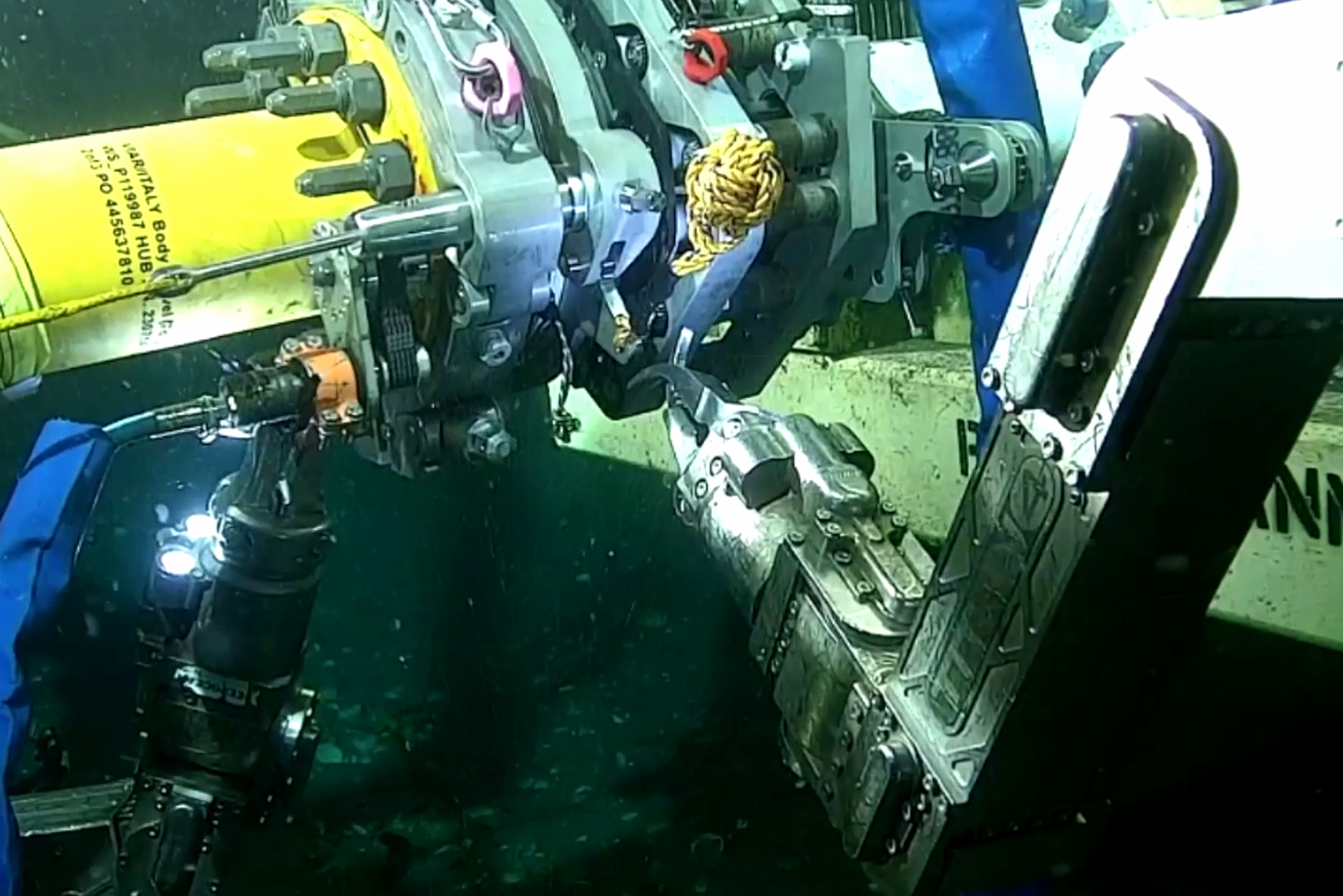
DeepOcean’s offering to conduct simultaneous routine inspection tasks and 3D scanning of subsea infrastructure consists of several specialist competencies, hardware and proprietary software solutions that enable both the subsea work and the subsequent processing of the data.
The complete package consists of inspection engineers, ROV pilots, ROVs equipped with specialised scanning equipment, data processing software that enables use of computer-aided drawings (CAD), ROV footage and sonar, digital twin, and proprietary subsea 3D Imaging software that converts the data to real 3D Models.
Photogrammetry is the science of obtaining reliable measurements and creating 3D information from photographs. It combines optics, geometry, computer vision, and imaging to convert 2D photos and other data into precise spatial data or full 3D reconstructions.
“We have over the past decade built up an internal ecosystem that enables us to achieve the desired savings in time, vessel days and costs,” adds Mikaelsen. “This isn’t just about software or hardware, but how our service is integrated with the overall subsea inspection offering and the wider business. And by applying 3D reconstructions in our operations, we improve our capacity to detect structural anomalies like cracks or deformities and understand their proximity to critical components within our clients’ subsea assets, enabling timely maintenance and preventing failures.”
Industry first?
At Woodside’s Sangomar Phase 1 Development, located offshore Senegal, DeepOcean was tasked with executing a scanning-for-planning campaign covering 69 subsea structures, including 17 subsea trees. The objective of the campaign was to capture high-resolution data to support detailed planning and execution of future inspection and maintenance activities.
“We completed the simultaneous operation at slightly above half the time it would traditionally take to perform two separate operations, while doubling the data output for Woodside,” says Robin Mawhinney, Executive Vice President for DeepOcean’s EMEA region. “We believe performing the simultaneous operation at scale without deployment of additional personnel on board was an industry first, but the most important thing is that we have successfully proven that there are substantial time and cost savings associated with this approach.”
“We are constantly looking for solutions that enhance the efficiency and quality of our subsea operations,” says Ben Witton, Sangomar Subsea Lead at Woodside. “DeepOcean’s dual-scope approach has delivered meaningful gains by reducing offshore time while providing richer data across the Sangomar field. This kind of innovation supports safer, more informed decision-making for future inspection and maintenance activities, and we’re pleased to see the benefits realised at scale.”
Subsea IMR scope
In June 2024, DeepOcean announced that it had been engaged by Woodside to provide subsea inspection, maintenance, and repair (IMR) services for the Sangomar field located offshore Senegal. DeepOcean’s scope of supply includes project management, engineering, and execution of subsea services such as inspection, survey, intervention, and maintenance, as well as additional services such as underwater inspection of FPSO (UWILD) and standalone ROV operations.
The Sangomar deepwater oil field is located 100 kilometres south of Dakar, Senegal, and commenced production in June 2024.
DeepOcean has operational sites in Congo-Brazzaville, Equatorial Guinea, Gabon and Ghana in West Africa. The subsea scope was conducted from the offshore subsea construction vessel, Island Ocean which is operating in the region.
(ENDS)
For further information, please contact:
Kjetil Sørum
M | +47 996 02 964
E | communications@deepoceangroup.com
About DeepOcean
DeepOcean is a world-leading ocean services provider, enabling energy transition and sustainable use of ocean resources, offering survey, engineering, project management, installation, maintenance, and recycling services for oil and gas, offshore renewables, deep sea minerals, and other ocean services.
Across the global offices, DeepOcean is a trusted independent solutions provider with highly skilled industry experts, using world-class fit-for-purpose tools and technology to drive cost-efficient and safe operations. The company delivers innovative engineering solutions focusing on remote and unmanned operations and digitally enabled services while continuously striving to lower the carbon footprint.
DeepOcean is owned by Triton, a leading European mid-market sector-specialist investor. As an active owner, Triton supports its portfolio companies to reach their full potential and works closely with DeepOcean to drive value creation. Founded in 1997, Triton invests in businesses that provide important goods and services in the Business Services, Industrial Tech and Healthcare.
.jpg)